
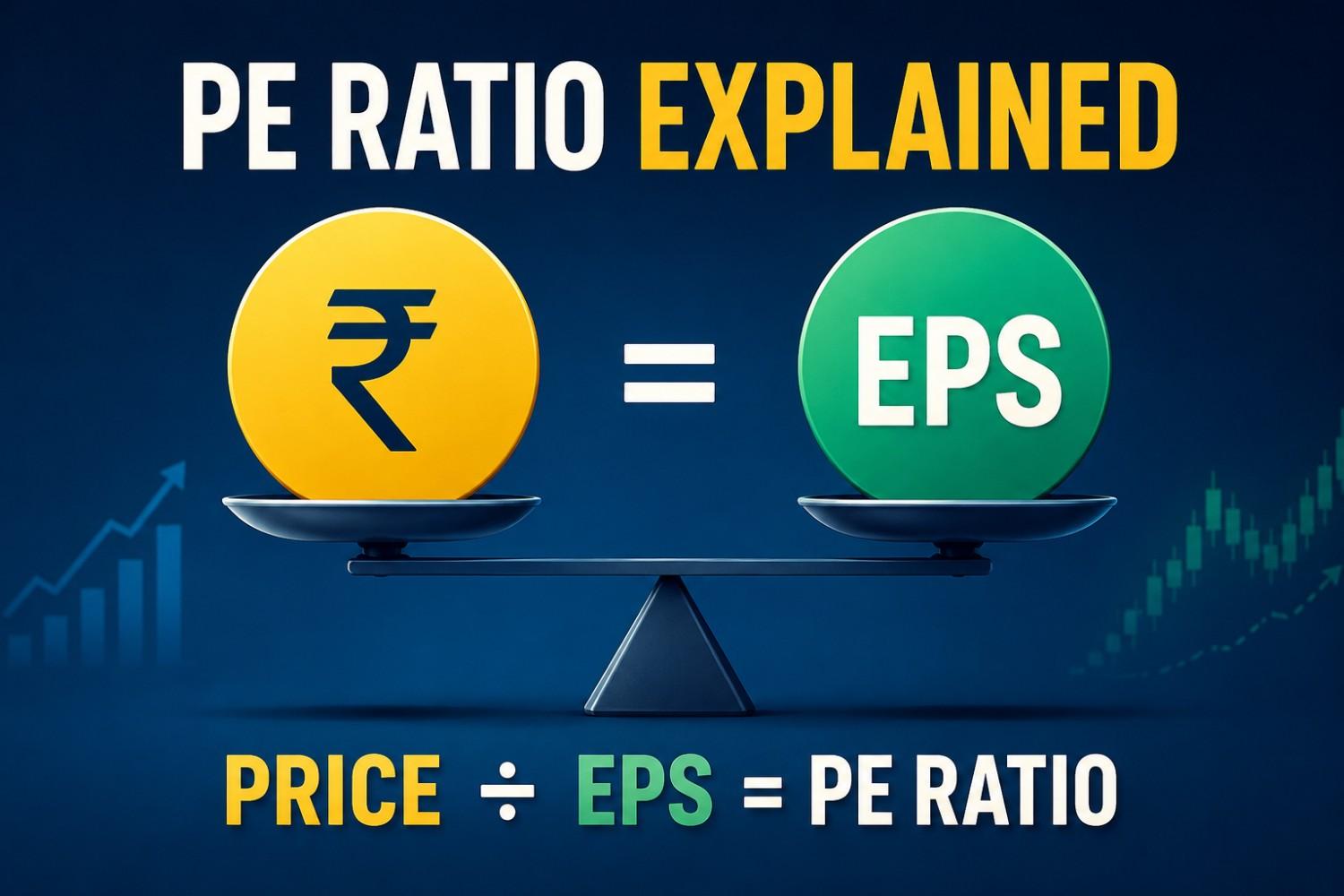
What Is PE Ratio and How to Use It to Value a Stock
Two investors buy into the same industry. One pays ₹500 for a company earning ₹25 a share. The other pays ₹500 for a company earning ₹10 a share. Same price tag — very different value. The number that exposes this gap is the PE ratio, yet most beginners stare at the share price and never check it.
Quick Answer
The PE ratio (price-to-earnings ratio) measures how much investors are willing to pay for every ₹1 of a company's earnings. It is calculated by dividing a company's share price by its earnings per share (EPS). A lower or higher PE ratio doesn't automatically make a stock good or bad—you should always compare it with the company's industry, historical valuation, growth prospects, and overall financial health before making an investment decision.
PE ratio = Share Price ÷ EPS—what you pay per rupee of profit. A "good" PE depends on the industry, growth, and market mood; there's no single ideal figure. A low PE isn't automatically cheap, and a high PE isn't automatically overpriced. Trailing PE uses past earnings; forward PE uses expected future earnings. PE is one clue, never the full answer—read it alongside other numbers. The PE ratio tells you how many years of today's earnings you're paying for upfront. A PE of 15 roughly means 15 years of unchanged profit to earn back your price. It also reflects expectations: a high number signals hopes of strong future profit growth, and a low number signals modest expectations—or a stock the market has simply overlooked. The formula is simple: PE Ratio = Market Price per Share ÷ Earnings per Share (EPS) And EPS, taken from the company's financial statements: EPS = Net Profit ÷ Total Number of Shares Example: a share trades at ₹400 with an EPS of ₹20. Its PE is 400 ÷ 20 = 20 — you pay ₹20 for ₹1 of profit. Most platforms show PE automatically, but knowing the math helps you trust the number. Trailing PE uses actual EPS from the last 12 months — real, reported results. Forward PE uses analysts' estimated EPS for the year ahead—forward-looking but based on forecasts. Trailing PE is more reliable; forward PE better reflects fast-growing companies whose past profit understates their future. Careful analysis checks both. A high PE usually means investors expect rapid growth, or the stock is simply in demand and richly priced. Quality names can carry high PEs for years. A low PE may flag an undervalued, overlooked stock—or weak prospects and falling profits. That's why a low PE isn't always better: cheap can mean value, or cheap for a reason. There's no universal "good" PE; context decides. Compare a stock's PE with its own history, direct competitors, the sector average, and the broader index like the Nifty 50. A bank and a software firm naturally trade at different levels, so cross-sector comparisons mislead. A stock priced below its peers and its own past may deserve a closer look—once you know why. Two firms in the same sector both trade at ₹300. Company A has a PE of 15; Company B, 30. On earnings, you pay double for B—justified only if B grows profit far faster or is much higher quality. Comparing P/E side by side, within one industry, quickly shows which stock the market prices richly and whether that premium is deserved. For any stock listed on NSE and BSE, the PE ratio appears on exchange sites, financial portals, and inside your investing app. After you open a demat account and trading account, your broker's platform typically shows trailing PE beside price, EPS, and market capitalization. No. PE ignores debt, cash flow, book value, management quality, and the shareholding pattern. A loss-making company has no meaningful PE, since there's no positive profit to divide by. One-off gains can distort EPS and make PE look artificially low. Treat PE as a starting filter for valuation, not a final verdict on intrinsic value. Many first-time investors misunderstand the PE ratio and end up making poor investment decisions. Avoid these common mistakes: Buying a stock only because it has a low PE ratio. A low PE may indicate weak business performance rather than a bargain. Comparing companies from different industries. A software company and a banking stock naturally have different valuation levels. Ignoring future earnings growth. A higher PE can be justified if a company is expected to grow rapidly. Overlooking debt and cash flow. The PE ratio doesn't show a company's debt burden or cash generation. Relying only on one financial ratio. Always use the PE ratio along with metrics like EPS, ROE, debt-to-equity ratio, and financial statements before making an investment decision. Beginners — an easy first check on whether a stock looks pricey. Long-term investors — to weigh valuation against history and peers. Swing and intraday traders — less central, as they focus on price action, though PE still frames overall value. Should beginners rely on PE before buying? Use it as one input, never the sole reason to buy. Scenario 1 — Correct usage: An investor compares two same-sector stocks, checks each PE against its history and the sector average, then reads the financials before deciding. PE shapes the shortlist, not the final call. Scenario 2 — Average usage: A beginner picks the stock with the lower PE but skips growth and debt checks. A fair start—incomplete analysis. Scenario 3 — Risk warning: Someone buys only because a PE looks "low," missing that profits are shrinking. It stays cheap for a reason. No ratio guarantees returns. Is this good for beginners? Yes, as an easy first filter — not a standalone signal. What are the risks? Relying on PE alone, or comparing across unrelated sectors. When should you use it? While shortlisting and comparing similar companies. What mistakes should you avoid? Treating a low PE as automatically cheap and ignoring debt and growth. PE Ratio: Price paid per ₹1 of a company's annual earnings. EPS (Earnings per Share): Net profit divided by total shares. Net Profit: Company earnings after all expenses and taxes. Trailing PE: PE using the past 12 months' earnings. Forward PE: PE using estimated future earnings. Market Capitalization: Share price × total shares; the company's total market value. Intrinsic Value: An estimate of a company's true worth from its fundamentals. Key Insight The PE ratio is a comparison tool, not a buy signal. It's most powerful when you weigh one company against similar companies and against its own past and least reliable when used alone. The PE ratio is one of the simplest ways to test whether a share price makes sense against its earnings. Calculate it, read both trailing and forward versions, and compare within the same industry. Treat it as your first research question, not the last word, alongside financials, debt, and business quality. This article is for educational purposes only and is not financial advice. It does not recommend any stock, sector, or broker. Investing in securities carries risk. Please consult a SEBI-registered investment adviser before making any investment decision.TL;DR
What the PE Ratio Actually Tells You
How to Calculate the PE Ratio of a Share
Trailing vs Forward PE
High PE vs Low PE: What They Mean
What Is a Good PE Ratio in India?
How to Use PE to Compare Two Companies
Where to Find the PE Ratio of an Indian Stock
Can PE Alone Tell You If a Stock Is Cheap?
Common Mistakes Beginners Make While Using the PE Ratio
At-a-Glance Summary
Who Should Use the PE Ratio?
Three Scenarios
Quick Questions
Glossary
Conclusion
Disclaimer