
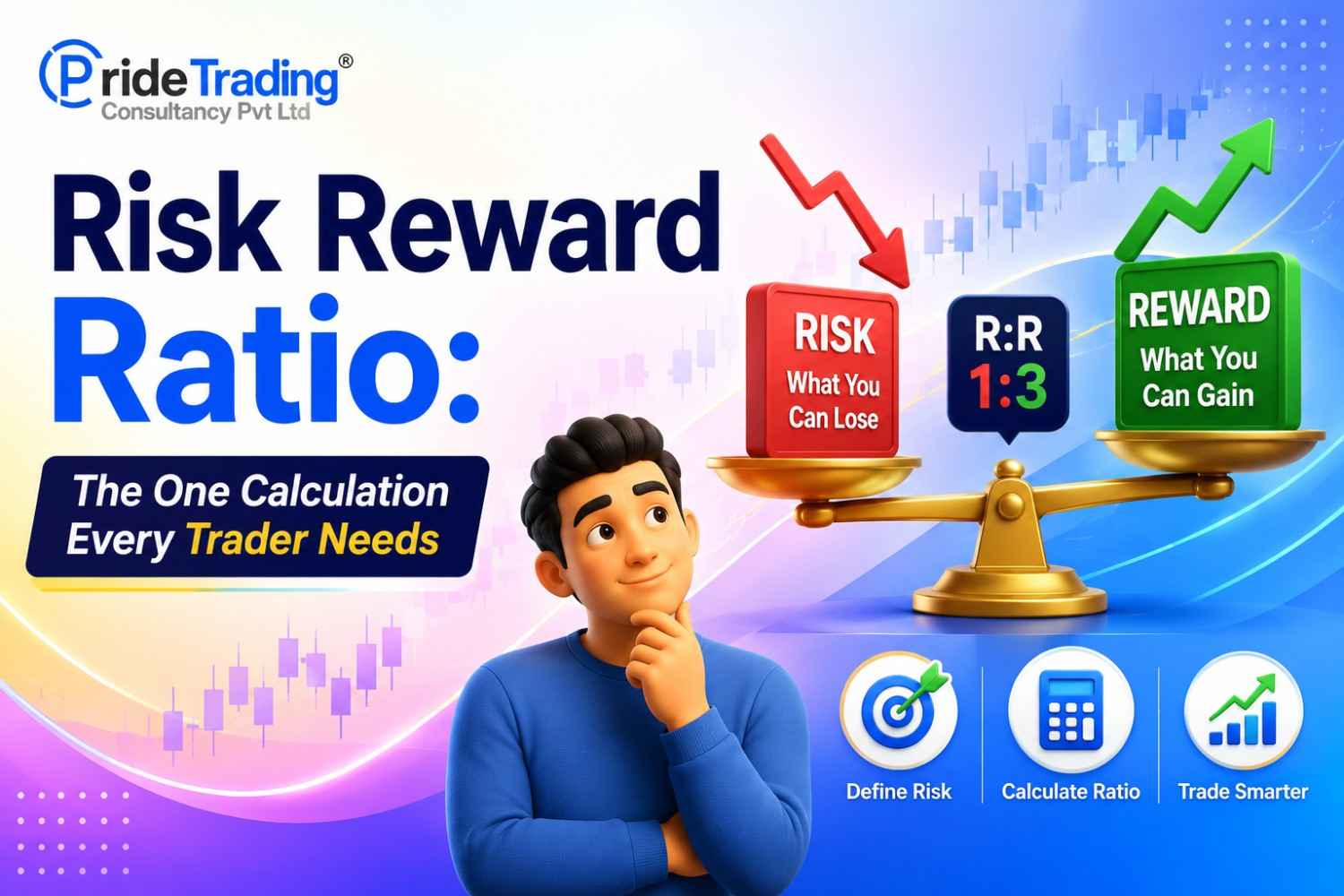
Risk Reward Ratio in Trading Explained: Complete Beginner Guide 2026
You find a trade that can make 1,000 rupees in profit but risks 5,000 rupees. Would you take it?
Most professional traders would say no immediately. Not because the profit looks bad, but because the math does not work in their favor. If you take 10 trades like that and win 6 of them, you still lose money overall.
This is exactly where risk-reward ratio becomes one of the most important concepts in all of trading. It is not complicated. But most beginners skip it entirely—and that skipping is one of the biggest reasons traders lose money consistently.
TL;DR
A risk-reward ratio compares potential loss to potential profit before you enter a trade. Many traders consider a 1:2 risk-reward ratio a commonly used benchmark, though the appropriate ratio varies based on strategy, market conditions, and risk tolerance. It improves consistency even when not every trade wins. It is the core of all trading risk management.
This is not financial advice. Consult an SEBI-registered research analyst before trading.
What Is the Risk-Reward Ratio in Trading?
The risk-reward ratio is the relationship between how much you can lose on a trade versus how much you can gain.
Before entering any trade, two numbers must be defined. Your stop loss is the price at which you exit if the trade goes wrong. Your target is the price at which you exit if the trade goes right.
The distance between your entry and stop loss is your risk. The distance between your entry and your target is your reward. The ratio between those two numbers is your risk-reward ratio.
A 1:2 risk reward ratio means you are risking 1 rupee to potentially make 2 rupees. A 1:3 ratio means risking 1 to make 3.
Every professional trader calculates this before placing a single order. Not after. Before. This one habit separates disciplined traders from those who trade on instinct and hope.
Risk Reward Ratio Formula
The formula is simple.
Risk Reward Ratio = Potential Loss divided by Potential Profit
Example: Entry Price: 100 rupees Stop Loss: 95 rupees Target: 110 rupees
Risk = 100 minus 95 = 5 rupees. Reward equals 110 minus 100, which equals 10 rupees Risk Reward Ratio = 5 divided by 10 = 1:2
You risk 5 rupees to potentially gain 10. That is a 1:2 ratio. For every rupee you risk, you aim to make 2.
This calculation takes 30 seconds. Yet most retail traders in India never do it before entering a trade.
Why Risk Reward Ratio Matters
It protects your capital. When you define the ratio before entering, you know exactly what you stand to lose. No surprises.
It improves decision-making. Not every setup with a good chart pattern is worth trading. If the target is too close to the entry or the stop loss is too wide, the ratio will tell you the trade does not make sense. Walk away.
It prevents emotional trading. When the math is calculated upfront, you do not need to make decisions mid-trade. The trade either hits your target or your stop-loss. Both outcomes were planned.
It builds long-term consistency. This is the most underrated benefit. A trader who consistently takes 1:2 and 1:3 setups can be profitable even with a 40 to 45 percent win rate. The winning trades are large enough to cover the losing ones.
Understanding Different Risk Reward Ratios
1:1 Risk Reward Ratio
You risk 10 rupees to make 10 rupees. On paper it sounds fair. In practice, it is very difficult to sustain. You need to win more than 50 percent of your trades just to break even after brokerage and taxes. A 1:1 risk-reward ratio generally requires a higher win rate to remain profitable after trading costs and execution factors. Not recommended as a primary strategy.
1:2 Risk Reward Ratio
You risk 10 rupees to make 20 rupees. This is the minimum ratio most professional traders accept. At a 40 percent win rate, you are still profitable. It gives you room to be wrong more often than you are right and still come out ahead over time. This is the most commonly recommended ratio for beginners learning trading risk management.
1:3 Risk Reward Ratio
You risk 10 rupees to make 30 rupees. At this ratio, even a 30 percent win rate keeps you in profit. It's harder to find setups that offer this ratio consistently, but when you do, the math works strongly in your favor. Common in swing trading where holding time allows larger price moves.
1:5 Risk Reward Ratio
You risk 10 rupees to make 50 rupees. Rare in intraday. More achievable in positional and trend-following trades. When a genuine trend is identified early, these ratios are possible. But chasing 1:5 setups on every trade leads to overtrading and missed opportunities.
Best Risk Reward Ratio for Intraday Trading
In intraday trading, time is compressed. You have 6 hours. Stocks move, reverse, and move again.
Most experienced intraday traders target a 1:1.5 to 1:2 risk reward ratio. Going for 1:3 or higher in intraday often means setting targets so far from entry that the stock rarely reaches them within one session.
Volatility matters here. High-volatility stocks may offer wider intraday ranges and different risk-reward opportunities. and banking heavyweights allow wider intraday ranges and better ratio setups. Low-volatility FMCG stocks rarely offer clean 1:2 intraday setups.
Combining the ratio with a clear stop loss based on the previous candle low or support zone is the standard approach. Entry defined. Stop loss placed. The target was calculated. Ratio checked. Only then does the order go through.
Best Risk Reward Ratio for Swing Trading
Swing trades are held for 2 to 10 days. The extra holding time allows for larger price moves—and therefore better risk-reward ratios.
A 1:2 ratio is the floor for swing trades. Most good swing setups offer 1:3 or better because the stock has room to move meaningfully over multiple sessions.
Stop losses in swing trading are typically wider to account for overnight gaps and session-to-session fluctuations. A wider stop loss means the position size must be smaller to keep the total rupee risk the same. This is where position sizing and risk-reward ratio work together.
Risk-Reward Ratio vs Win Rate
This section changes how most beginners think about trading.
Trader A wins 80 percent of trades but uses a 1:0.5 ratio. On 10 trades, 8 win (each making 5 rupees), and 2 lose (each losing 10 rupees). Total: 40 minus 20 = 20 rupees profit.
Trader B wins 40 percent of trades but uses a 1:3 ratio. On 10 trades, 4 win (each making 30 rupees), and 6 lose (each losing 10 rupees). Total: 120 minus 60 equals 60 rupees profit.
Trader B makes 3 times more money despite winning only 40 percent of the time.
This is the most powerful insight in all of trading risk management. You do not need to be right most of the time. You need your winning trades to be significantly larger than your losing ones. A risk-reward ratio is how you guarantee that mathematically.
How to Calculate Risk Reward Ratio Before Entering a Trade
Step 1 — Identify your entry price. The exact price at which you plan to buy.
Step 2 — Set your stop loss. Where will you exit if the trade goes wrong? Use technical levels—support zones, previous swing lows, or ATR-based distances.
Step 3 — Define your target. Where will you exit if the trade goes right? Use resistance zones, previous highs, or Fibonacci extensions.
Step 4 — Calculate your risk. Entry price minus stop loss price.
Step 5 — Calculate your reward. Target price minus entry price.
Step 6 — Evaluate the trade. Divide risk by reward. If the ratio is below 1:1.5, reconsider. If it is 1:2 or better, the trade meets the minimum standard.
Only enter if the ratio meets your minimum. Discipline here is everything.
Real Trading Example
Entry: 500 rupees Stop Loss: 480 rupees Target: 560 rupees
Risk = 500 minus 480 = 20 rupees. Reward = 560 minus 500 = 60 rupees Risk Reward Ratio = 1:3
If this trade wins, you make 60 rupees per share. If it loses, you lose 20 rupees per share. Over 10 such trades, if only 4 win, you make 240 rupees while losing 120 rupees. Net profit: 120 rupees despite losing 6 out of 10 trades.
This is why the ratio matters more than the win rate.
How Risk Reward Ratio Works with Stop Loss
Risk-reward ratio and stop loss are inseparable. One without the other is incomplete.
Your stop loss defines your risk. Without a stop loss, your risk is theoretically unlimited — the stock could fall to zero. With a stop loss, your risk is exactly the distance between your entry and the stop level.
Your target defines your reward. Without a target, you do not know when to take profit. Trades that have no defined target often end in emotional exits — either too early (leaving money on the table) or too late (watching a profit turn into a loss).
Together, stop loss and target give you the numerator and denominator of the risk reward ratio formula. Both must be set before the trade is entered.
For a deeper understanding of stop loss, read our complete guide on stop loss in trading at pridecons.com.
Risk Management and Position Sizing
Professional traders combine three things: risk reward ratio, stop loss, and position sizing.
Position sizing determines how many shares to buy based on how much you are willing to lose on the trade.
Example: Your account has 100,000 rupees. You are willing to risk 2 percent per trade—that is 2,000 rupee maximum loss. Your stop loss is 20 rupees away from entry. Divide 2,000 by 20, and you get 100 shares. That is your position size.
This ensures that even if the stop loss triggers, you lose exactly 2,000 rupees — 2 percent of your account. Not more.
Combine this with a 1:2 risk-reward ratio, and your winning trades return 4,000 rupees while losing trades cost 2,000 rupees. Over time, even a moderate win rate builds capital consistently.
Common Mistakes Traders Make
Ignoring the stop loss: Trading without a stop loss means the risk side of the ratio is undefined and potentially unlimited. Every trade needs a stop loss. No exceptions.
Taking poor ratios out of impatience: A trade with a 1:0.8 ratio might look tempting because the setup appears strong. But the math does not support it. Skip it and wait for a better setup.
Moving targets emotionally: You set a target at 560, but the stock stalls at 540. You tell yourself to hold for more. The stock reverses to 510. You exit at a smaller profit than planned or at a loss. Set the target. Honor it.
Chasing trades: You miss the entry and buy higher to avoid missing the move. Now your risk has increased, but your target has not moved. The ratio deteriorated, and you entered anyway. This is one of the most common mistakes in intraday trading.
Glossary
Risk Reward Ratio: The comparison between potential loss and potential profit on a trade. Expressed as 1:2, 1:3, and so on.
Stop Loss: A pre-set price at which your trade closes automatically to limit loss. The risk side of the ratio.
Target Price: The price at which you plan to exit if the trade moves in your favor. The reward side of the ratio.
Position Sizing: Calculating how many shares to buy based on your total capital, acceptable risk per trade, and stop-loss distance.
Win Rate: The percentage of your trades that are profitable. The risk-reward ratio determines whether a given win rate is sufficient for overall profitability.
Conclusion
Successful trading is not about winning every trade. It is about ensuring that your winning trades are larger than your losing trades. The risk-reward ratio in trading is the tool that guarantees this mathematically. Calculate it before every trade. Accept only setups that meet your minimum threshold. Combine it with a well-placed stop loss and correct position sizing. Do this consistently, and even a 40 percent win rate can build wealth over time. At PrideCons, our SEBI-registered research helps Indian traders approach every setup with the discipline and data that trading risk management actually requires. Registration number INH000010362.
Disclaimer
This blog is for educational and informational purposes only. This is not financial advice and should not be treated as a recommendation to buy or sell any security. Trading in the Indian stock market involves significant risk of capital loss. All examples used are hypothetical and for illustration purposes only