
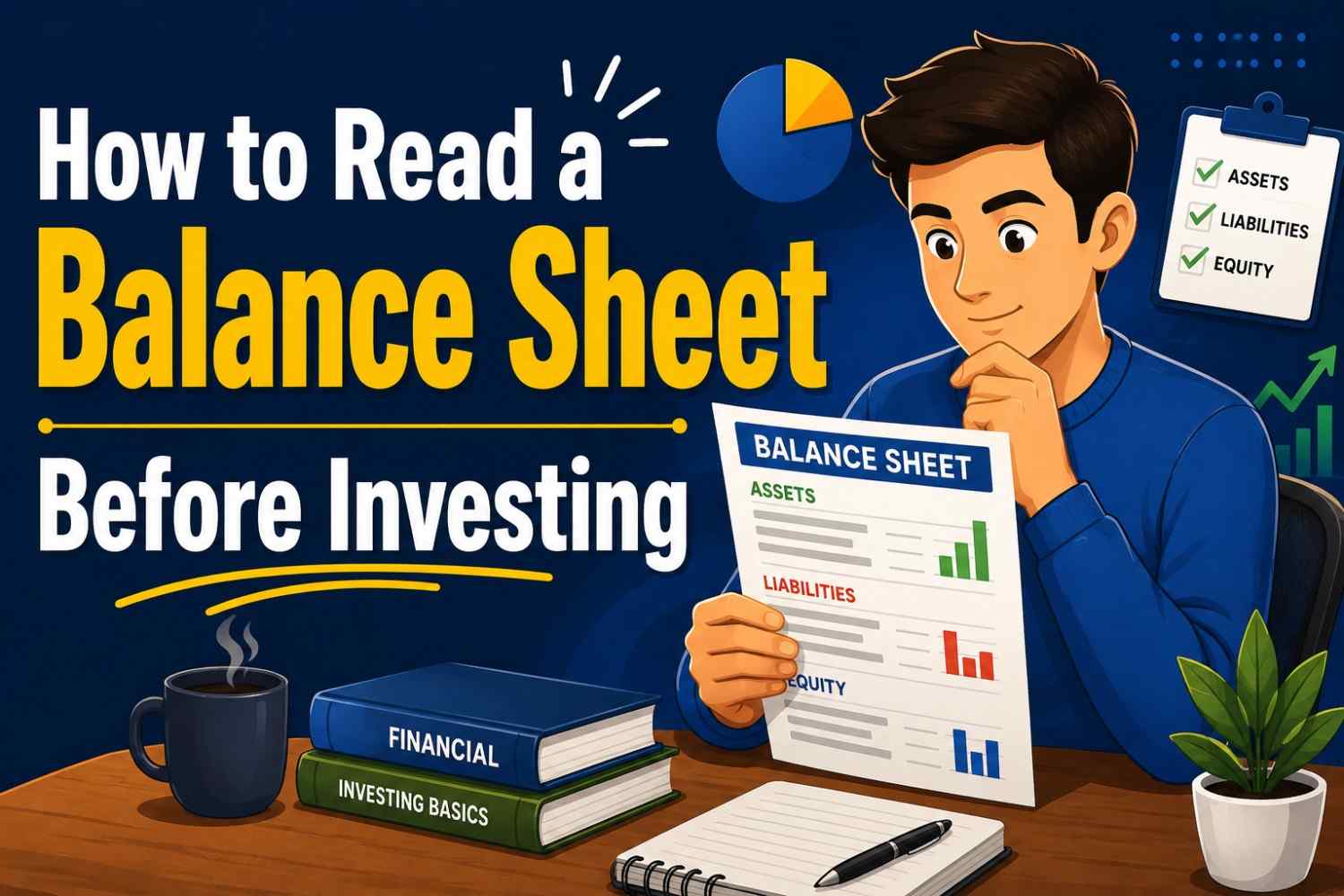
How to Read a Balance Sheet Before Investing
Two companies report the same profit this year. One is debt-free with cash in the bank; the other survives on short-term loans and unpaid bills. The profit figure hides this gap completely — but the balance sheet reveals it in seconds. That's why experienced investors read it before buying a stock.
Quick Answer
A balance sheet is a financial statement that shows what a company owns (assets), what it owes (liabilities), and what belongs to shareholders (equity) on a specific date. Before investing, it helps you understand a company's financial strength, debt levels, cash position, and overall stability—details that profit figures alone cannot reveal.
TL;DR
A balance sheet has three parts: assets, liabilities, and shareholders' equity.
It shows financial health at a point in time — unlike a profit and loss statement, which covers a period.
Key checks: debt levels, cash, working capital, and the debt-to-equity ratio.
You'll find a company balance sheet in the annual report and on financial portals.
It's one piece of research, never a buy signal on its own.
The Three Main Parts of a Balance Sheet
Every balance sheet is built on one equation: Assets = Liabilities + Shareholders' Equity. These are its three main parts.
Assets are what the company owns. Current assets turn into cash within a year — cash and cash equivalents, inventory, and accounts receivable (money customers owe). Non-current assets are long-term, such as land, machinery, and buildings.
Liabilities are what the company owes. Current liabilities are due within a year; long-term debt is repaid over many years. Together they form total debt.
Shareholders' equity is what remains for owners after subtracting liabilities from assets. It's also called net worth or book value.
So the difference between assets and liabilities is simple: assets bring value in, liabilities are claims against it, and equity is the leftover that belongs to shareholders.
How to Read a Balance Sheet: Step by Step
Here's how to read a company's balance sheet before buying a stock:
Confirm the equation balances—assets equal liabilities plus equity.
Compare current assets with current liabilities to judge working capital and short-term strength.
Check total debt, especially long-term debt, against equity.
Look at cash and cash equivalents — real cash signals resilience.
Compare two or three years to spot the trend, not just one snapshot.
Balance Sheet Checklist Before Investing
Before investing in any company, quickly review these points:
Are current assets higher than current liabilities?
Is the company's debt under control?
Does it have enough cash and cash equivalents?
Is shareholders' equity increasing over time?
Is working capital positive?
Compare at least the last 3 years instead of relying on a single year's data.
A Simple Financial Example In this example, the company has more assets than liabilities and positive working capital, which generally indicates good short-term financial health. If shareholders' equity has also been increasing consistently over the past few years, it can be a positive sign for long-term investors. Beginners often confuse the two. A balance sheet is a snapshot on one date; a profit and loss statement shows income and expenses over a period. Both sit within the financial statements, alongside the cash flow statement. Reading both together gives a fuller picture—see How to Read a Profit & Loss Statement. To check whether a company carries too much debt, use the debt-to-equity ratio: total debt divided by shareholders' equity. A lower ratio generally means less financial strain, though what counts as "high" varies by industry. Also compare current assets with current liabilities — if short-term dues repeatedly exceed short-term assets, that's a warning. The debt-to-equity ratio explains the math in detail. Watch for these balance sheet red flags before investing: Debt rising faster than equity, year after year. Very little cash despite reported profits. Receivables or inventory ballooning—customers may not be paying, or goods aren't selling. Current liabilities consistently higher than current assets. Sudden, unexplained jumps in "other" assets or liabilities. None of these alone condemns a company, but a cluster of them deserves real caution. In India, you can find a listed company's balance sheet in its annual report, on the NSE and BSE websites, on the company's investor-relations page, and on most financial portals. You don't need to build one in Excel yourself—companies publish it in a standard format. Reviewing it alongside the shareholding pattern adds useful context. Most listed companies publish their balance sheet in a standard format, making it easier for investors to compare businesses across different industries. You can also review previous years' balance sheets to identify long-term financial trends instead of relying on a single year's data. Beginners — to avoid buying financially weak companies. Long-term investors — to judge stability before holding for years. Swing and intraday traders — less critical, as they focus on price, but still useful for avoiding fragile firms. Do you need to understand balance sheets before investing? Not perfectly, but even a basic reading protects you from obvious risks. A company's balance sheet generally reflects strong financial health when it has: Positive working capital Manageable debt levels Healthy cash reserves Growing shareholders' equity Consistent financial performance over multiple years These indicators don't guarantee a good investment, but they can help you identify financially stronger companies during your initial research. Is this good for beginners? Yes — start with the three parts and the debt check. What are the risks? Reading one year in isolation or ignoring rising debt. When should you use it? Before buying, and when reviewing existing holdings. What mistakes should you avoid? Trusting profit alone without checking financial position. Looking only at profit and ignoring the balance sheet entirely. Judging one year instead of a multi-year trend. Overlooking off-book or steadily rising debt. Confusing high assets with a healthy business—debt-funded assets can be risky. Forgetting to compare figures with industry peers. Ignoring the cash flow statement and relying only on the balance sheet. A financially strong company should be evaluated using the balance sheet, profit and loss statement, and cash flow statement together. Assets: What a company owns. Liabilities: What a company owes. Shareholders' Equity: Assets minus liabilities; the owners' share, also called net worth or book value. Working Capital: Current assets minus current liabilities. Debt-to-Equity Ratio: Total debt divided by equity; a gauge of financial risk. Annual Report: A company's yearly document containing its financial statements. Key Insight A balance sheet answers one question profit can't: is the company financially strong? Reading assets, liabilities, and debt together — across a few years — matters far more than any single number. Scenario 1 — Correct usage: An investor checks three years of balance sheets, sees falling debt and rising equity, then reads the P&L and cash flow before deciding. Balance sheet strength supports the decision. Scenario 2—Average usage: A beginner glances at one year, notices low debt, and feels reassured—a fair start, but a single snapshot can mislead. Scenario 3 — Risk warning: Someone buys on strong profits alone, ignoring heavy short-term debt. When repayment pressure hits, the stock suffers. Strong profit never guarantees a strong balance sheet. While the balance sheet shows a company's financial position, the PE ratio helps investors understand whether a stock's market valuation looks reasonable. Learning how to read a balance sheet turns you from a price-watcher into an informed investor. Focus on the three parts, check debt and working capital, and always compare a few years. Treat it as one essential tool within your wider research—never the only one. This article is for educational and investor-education purposes only; it is not financial advice. It does not recommend any stock or broker. Investing in securities carries risk. Please consult a SEBI-registered research analyst before making any investment decision.Balance Sheet vs Profit & Loss Statement
How to Check If a Company Has Too Much Debt
Balance Sheet Red Flags to Watch
Where to Find a Company's Balance Sheet in India
Who Should Learn to Read a Balance Sheet?
Financial Health Indicators
Quick Questions
Common Mistakes Beginners Make
Glossary
Three Scenarios
Conclusion
Disclaimer