
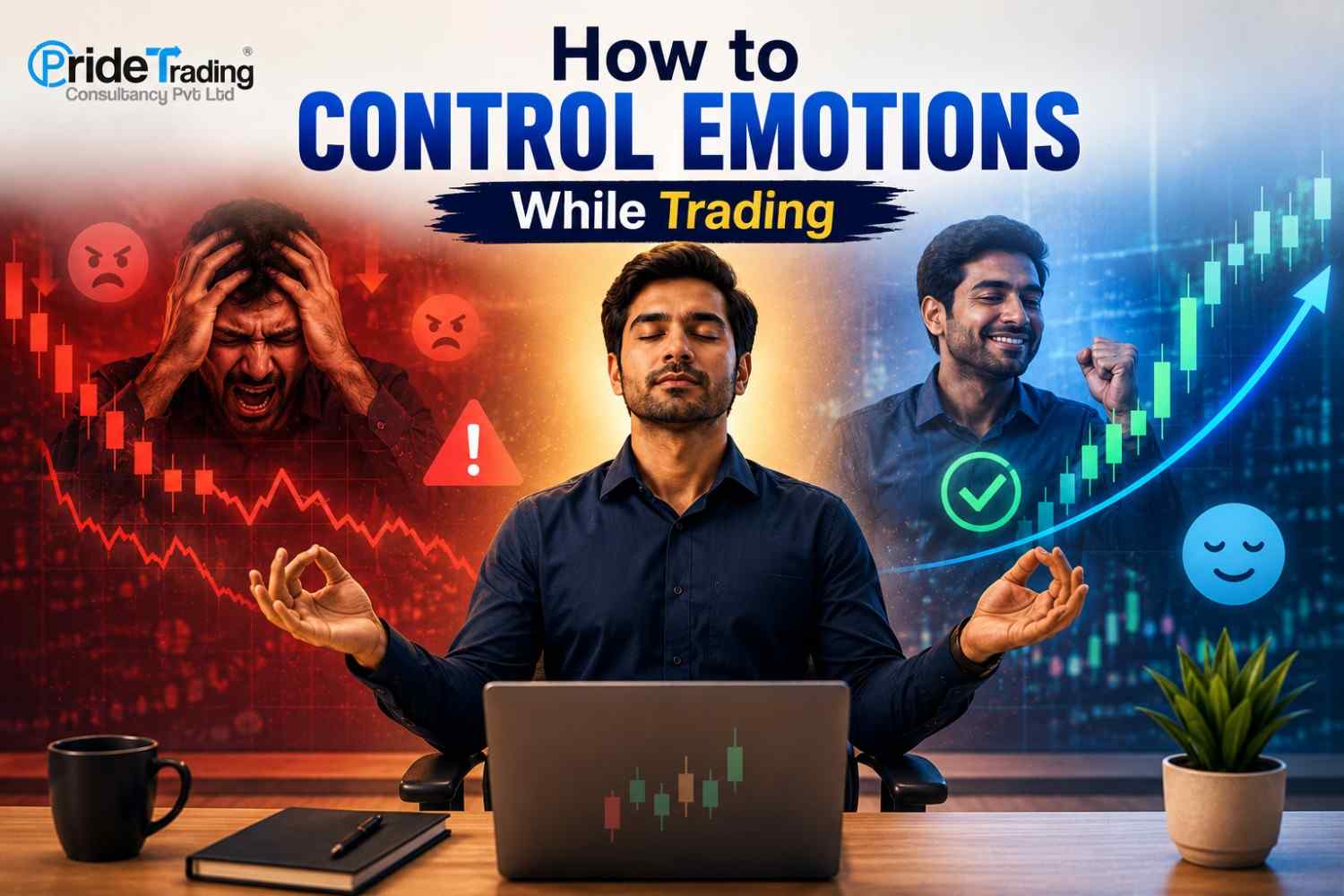
How to Control Emotions While Trading: A Practical Guide for Indian Traders
You have done your analysis. The chart looks clean. The setup is valid. You enter the trade. Three minutes later, the stock dips slightly and your heart rate jumps. You exit. The stock then moves exactly where you expected—without you in it.
Or the opposite. A trade goes wrong. You know the stop loss is there for a reason. But you move it down, just once, because this one feels different. It keeps falling. You hold. It falls further. Now a ₹3,000 loss has become ₹18,000.
Neither of these situations involves a failure of technical knowledge. Both are failures of emotional control — and they cost Indian traders more money every single day than poor strategy selection ever does.
Why Emotions Matter in Trading
Markets are built on collective human behavior. Every price movement reflects millions of individual decisions, most of which are influenced by emotions rather than pure logic.
Fear makes traders exit profitable positions too early or avoid valid setups entirely after a losing streak. Greed keeps traders in positions long past their target because they want just a little more. Hope is what makes a trader hold a losing position without a stop loss, waiting for a recovery that may not come.
Regret drives re-entry into a missed trade at a worse price—chasing what just happened instead of waiting for the next clean setup. Overconfidence follows a winning streak and leads to oversized positions, reduced analysis, and the assumption that the market owes you consistency.
Revenge trading is the impulse to immediately re-enter the market after a loss to win it back — often leading to a second, larger loss taken in emotional haste. FOMO, the fear of missing out, causes traders to enter late into moves that have already delivered most of their potential, buying high out of anxiety rather than analysis.
Every one of these emotional states is normal. The goal is not to eliminate them but to prevent them from making trading decisions.
The Biggest Emotional Trading Mistakes
Most trading losses trace back to a short list of repeatable emotional errors.
Entering without a clear plan removes the framework that keeps emotions in check. Moving a stop loss after entry turns a defined risk into an undefined one. Overtrading — taking more positions than your system allows — compounds both losses and the emotional fatigue that makes subsequent decisions worse.
Doubling a losing position to lower your average is a common retail habit that turns manageable losses into portfolio-damaging ones. Ignoring position sizing — putting too much capital into one trade because you are confident — is how single trades become catastrophic events.
Chasing momentum after a stock has already moved 6–8% means accepting a poor entry point driven by excitement rather than analysis. Taking profits too early because a trade looks uncomfortable, then watching it continue in your direction, trains you to underperform your own strategy. Holding losers too long because you cannot accept being wrong is the emotional trade-off that costs the most in both money and mental energy.
How Professional Traders Control Their Emotions
The separation between traders who sustain results and those who do not is rarely strategy. It is how consistently they execute the same plan under varying emotional conditions.
Professional traders follow a written trading plan — not because they lack confidence, but because they understand that in-the-moment decisions made under stress are reliably worse than pre-session decisions made with a clear head. The plan defines entry criteria, stop-loss placement, target, and position size before the market opens.
Risk management is not a separate concept from emotional control—it is the foundation of it. When you know your maximum loss on a trade is 1% of your capital, the emotional weight of that trade becomes proportional and manageable. When position sizing is ignored and a single trade represents 20% of your account, every price tick triggers a disproportionate emotional response.
Accepting losses as a natural cost of doing business — not as failures — is the mindset shift that takes the longest to build but matters the most. Professional traders think in probabilities: if a setup has a 55% win rate with a 1:2 risk-reward ratio, a string of losses does not invalidate the edge. Emotional traders treat each loss as personal.
10 Practical Ways to Control Emotions While Trading
1. Create a trading plan before market open. Write your criteria for entry, your stop loss level, your target, and your position size before you look at a live chart. Decisions made under pressure are almost always worse than those made in advance.
2. Use fixed risk per trade. Limit each trade to 1–2% of your total trading capital. This makes losses emotionally bearable and prevents single trades from controlling your psychology.
3. Never remove your stop loss. Place it at a technically valid level before entry and treat it as a non-negotiable boundary. A stop loss is not pessimism—it is your only tool for keeping losses defined.
4. Keep a trading journal. After every session, write down your entry reason, what happened, and — critically — what you were feeling when you made the decision. Patterns in emotional behavior become visible only when you document them consistently. A trading journal is one of the most underused tools in retail trading.
5. Take a break after consecutive losses. Three losing trades in a session is a signal to stop — not to try harder. Step away, reassess, and return the next day with a clear head rather than compounding emotional decisions.
6. Avoid revenge trading. After a loss, the impulse to immediately recover it through another trade is one of the most reliable ways to turn a contained loss into a large one. The market does not owe you a recovery session.
7. Limit your daily trade count. Setting a maximum of two to four trades per session removes the temptation to manufacture setups when none exist. Quality of analysis matters more than quantity of activity.
8. Focus on process, not outcome. A trade can be executed perfectly and still lose money. A trade can be executed poorly and still make money. Evaluating your process—did you follow your plan? — Rather than just the result, it builds durable discipline.
9. Review trades weekly, not daily. Daily P&L tracking amplifies emotional noise. Weekly reviews give you enough sample size to evaluate whether your approach is working without letting a bad Tuesday distort your view of the strategy.
10. Keep realistic expectations. Intraday trading and swing trading both involve losing trades. No trader, regardless of experience, wins every session. Expecting otherwise creates the emotional fragility that leads to plan deviation when losses arrive.
The Role of Trading Psychology
Most traders spend the majority of their preparation time on strategy—finding the right indicators, the right time frames, and the right setups. A much smaller amount of time goes into understanding their own psychological response to wins and losses.
This is backwards. A mediocre strategy executed with complete discipline will outperform a technically refined strategy executed emotionally over any meaningful time period. The reason is simple: emotional execution introduces random variation into a system that depends on consistency. You cannot measure an edge if you are not applying it the same way each time.
Understanding your own trading psychology — what triggers overtrading, what makes you remove stop losses, what FOMO feels like in your body before you act on it — is the real edge that separates sustainable traders from those who cycle through capital.
Two Traders, One Setup: A Realistic Example
Trader A and Trader B both identify the same breakout setup on a Nifty 50 constituent stock on the same day. The setup is valid. Entry is at ₹480, stop loss at ₹465, target at ₹510. Risk-reward is 1:2.
Trader A enters but immediately feels anxious when the stock pulls back to ₹474 after entry. He exits at ₹472, taking a small loss. The stock consolidates at ₹475 for twenty minutes, then moves to ₹512. He watches this happen.
Trader B entered the same position with a pre-session plan that said, "Stop loss is ₹465; I will not exit before that level." "When the stock dipped to ₹474, she referred to her plan, saw that her stop had not been hit, and waited. The stock hit her target at ₹510.
Same setup. Same analysis. Completely different outcomes — determined entirely by emotional response to a normal intraday pullback.
Common Myths About Trading Emotions
"Professional traders never experience emotion while trading." Every trader feels something. The difference is that experienced traders recognize the emotional signal and choose not to act on it without a plan-based reason.
"More trades mean more profit." More trades mean more transaction costs, more emotional decisions, and more noise. Disciplined selectivity outperforms hyperactivity in most trading accounts.
"A winning trade proves my analysis was correct." Not necessarily. A trade can win for the wrong reasons—random market movement, news, or noise. Evaluating analysis quality independently of trade outcome is a skill worth developing.
"A good strategy removes emotions." No strategy is immune to emotional interference during execution. Strategy defines what to do. Discipline defines whether you actually do it under pressure.
Checklist Before Every Trade
Use this before placing any order. If you cannot answer yes to every question, the trade is not ready.
Conclusion
Emotional discipline in trading is not a trait you are born with or without. It is built through consistent practice — planning trades before the session, accepting losses as a cost of participation, reviewing decisions honestly, and applying the same process across winning and losing stretches alike.
The traders who sustain results in Indian markets over time are not those with the most sophisticated strategies. They are the ones who execute a reasonable strategy with the most consistent discipline. That discipline comes from planning, journaling, and honest self-assessment—not from market prediction.
PrideCons publishes investor education and stock market for beginners content to help Indian traders and investors build the kind of foundational understanding that makes disciplined market participation possible. The markets will always carry uncertainty. Your response to that uncertainty is the one variable you can actually control.
Disclaimer: This article is for educational and informational purposes only. It does not constitute financial advice or a recommendation to engage in any trading or investment activity. Trading in equities and derivatives involves significant risk of loss. Please consult a SEBI-registered research analyst before making any trading decisions. PrideCons | SEBI Registered Research Analyst | INH000010362