
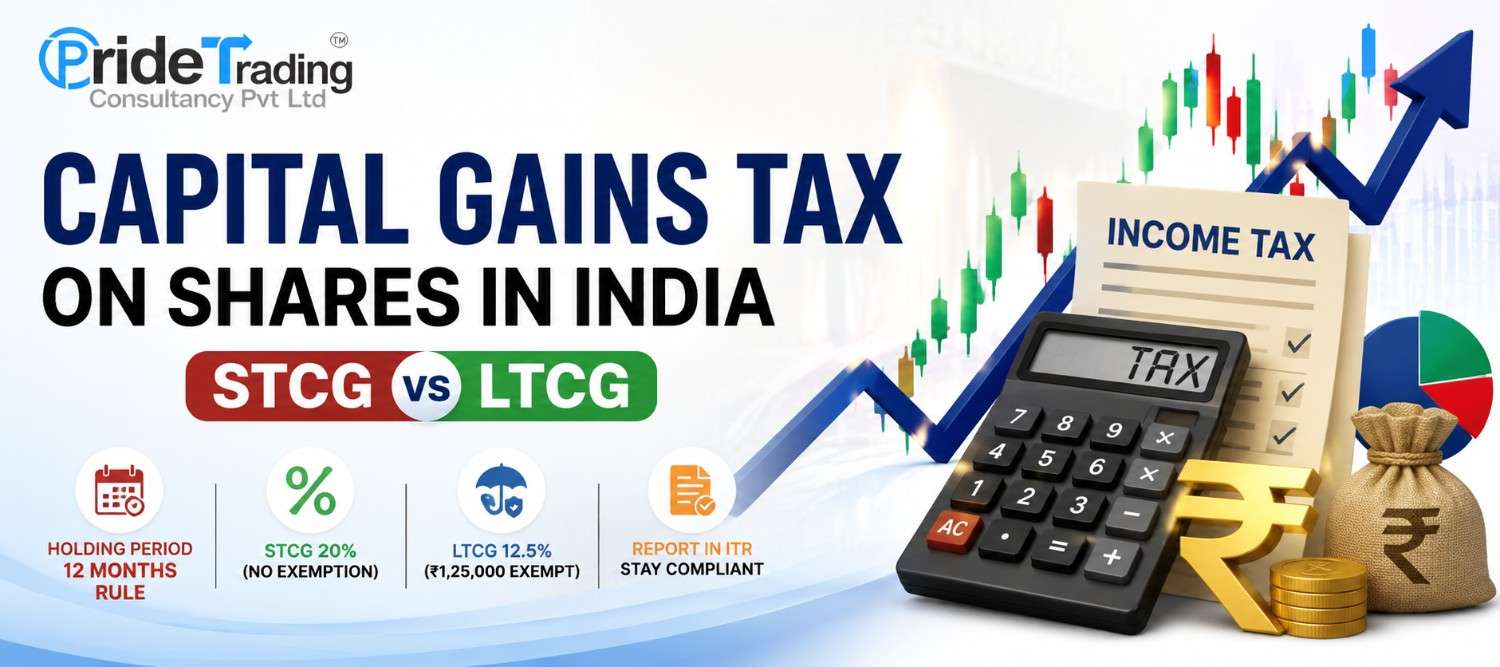
Capital Gains Tax on Shares in India: STCG vs LTCG Explained
Meera sold her shares of a large-cap stock last March. She had bought them fourteen months ago and made a profit of ₹1,80,000. When she checked her tax statement, she expected a large tax bill, but the actual amount was far lower than she assumed. The reason? Her gains qualified as long-term, and the first ₹1,25,000 was exempt.
Meanwhile, her colleague Arun sold his shares after just five months and paid a flat 20% tax on the entire profit. He had no exemption at all.
Both made a profit. Both sold shares. But the tax they paid was very different, simply because of how long each of them held their shares. This is why understanding capital gains tax on shares matters before you sell, not after.
Quick Answer: How Is Capital Gains Tax on Shares Calculated in India?
When you sell equity shares listed on a recognized stock exchange, the profit is taxed as either short-term or long-term capital gains. Shares sold within 12 months attract short-term capital gains (STCG) tax at 20% under Section 111A. Shares held for more than 12 months attract long-term capital gains (LTCG) tax at 12.5% under Section 112A, with the first ₹1,25,000 of LTCG exempt per financial year.
Last reviewed: July 2026
Tax laws may change through future Union Budgets. This article reflects publicly available provisions applicable to FY 2025–26 (AY 2026–27).
TL;DR
STCG on listed equity shares is taxed at 20% (Section 111A) with no basic exemption.
LTCG on listed equity shares is taxed at 12.5% (Section 112A), with ₹1,25,000 exempt per financial year.
The holding period threshold is 12 months—selling before that triggers STCG; selling after qualifies as LTCG.
Capital losses can be set off against capital gains, and certain losses can be carried forward.
Capital gains from share sales must be reported in your income tax return, regardless of whether tax is payable.
What Is Capital Gains Tax?
Capital gains tax is the tax levied on the profit you earn when you sell a capital asset, in this case equity shares, for more than what you originally paid. If you sell at a loss, there is no tax on that transaction, though the loss itself has implications for your overall tax position.
The tax treatment depends on how long you held the shares before selling. This distinction between short-term and long-term is central to how much tax you actually owe.
What Is STCG (Short-Term Capital Gains)?
If you sell listed equity shares within 12 months of buying them, the profit is classified as short-term capital gains.
Tax rate: 20% under Section 111A (applicable where Securities Transaction Tax, or STT, has been paid).
No exemption limit applies to STCG on equity — the entire profit is taxable.
Example: You buy 200 shares at ₹500 each (total cost: ₹1,00,000). You sell them 8 months later at ₹650 each (total sale: ₹1,30,000). Your STCG is ₹30,000, and the tax at 20% is ₹6,000 (plus applicable cess and surcharge).
What Is LTCG (Long-Term Capital Gains)?
If you sell listed equity shares after holding them for more than 12 months, the profit is classified as long-term capital gains.
Tax rate: 12.5% under Section 112A.
Exemption: The first ₹1,25,000 of LTCG per financial year is exempt from tax. Only gains above this threshold are taxed.
Example: You buy 500 shares at ₹400 each (₹2,00,000) and sell them 18 months later at ₹800 each (₹4,00,000). Your LTCG is ₹2,00,000. After the ₹1,25,000 exemption, only ₹75,000 is taxable. Tax at 12.5% = ₹9,375 (plus applicable cess).
STCG vs LTCG: At-a-Glance Comparison
How to Calculate Capital Gains on Shares
The basic formula is straightforward:
Capital Gain = Sale Price − Purchase Price − Transfer Costs
Transfer costs include brokerage paid on both the buy and sell side, plus any applicable charges. STT is already paid through the transaction and is a prerequisite for the concessional tax rates to apply.
Worked Example:
Purchase price: 300 shares × ₹600 = ₹1,80,000
Sale price: 300 shares × ₹900 = ₹2,70,000
Brokerage and charges (assumed): ₹500
Net Capital Gain: ₹2,70,000 − ₹1,80,000 − ₹500 = ₹89,500
If the holding period was 14 months, this qualifies as LTCG. Since ₹89,500 falls below the ₹1,25,000 annual exemption, no tax is payable in this case.
What Happens If You Sell Shares at a Loss?
If you sell shares at a loss, no capital gains tax is due on that transaction. However, the loss is not simply ignored.
Short-term capital losses can be set off against both STCG and LTCG in the same financial year.
Long-term capital losses can only be set off against LTCG, not against STCG.
Unabsorbed capital losses can generally be carried forward for up to 8 assessment years, subject to conditions.
This is a basic overview. Tax rules around loss set-off and carry-forward can be specific, so referring to the latest income tax provisions or consulting a qualified tax professional is recommended for individual circumstances.
Can I Reduce Capital Gains Tax Legally?
Hold shares beyond 12 months where appropriate.
Use eligible loss set-off provisions.
Maintain proper records.
File ITR correctly.
Do You Need to Report Capital Gains in Your ITR?
Yes. If you have sold shares during the financial year, you are required to report the transaction in your income tax return, even if the net gain falls below the exemption limit or you sold at a loss. Capital gains are disclosed in Schedule CG of ITR-2 or ITR-3, depending on your other sources of income. ITR-1 does not accommodate capital gains.
Maintaining proper records, including purchase date, purchase price, sale date, sale price, and broker contract notes, is essential for accurate reporting.
Three Scenarios: How Tax Treatment Differs
Scenario 1—Long-term sale with gains below exemption: An investor sells shares after 15 months with a profit of ₹1,10,000. Since this falls within the ₹1,25,000 LTCG exemption, no tax is payable, though the transaction still needs to be reported in the ITR.
Scenario 2 — Short-term sale with moderate gains: A trader sells shares after 4 months with a profit of ₹50,000. The full amount is taxable as STCG at 20%, resulting in ₹10,000 in tax (plus cess). No exemption applies.
Scenario 3 — Mistake: Ignoring the holding period: An investor sells shares 11 months after purchase, unaware that holding for one more month would have qualified the gain as LTCG with a lower rate and an exemption. Planning the sale date around the 12-month threshold could have meaningfully reduced the tax liability.
Common Mistakes Investors Make
Selling shares one or two weeks before the 12-month mark, missing LTCG treatment.
Forgetting to account for tax while calculating actual profit from a trade.
Not maintaining records of purchase date and price, creating difficulties during ITR filing.
Confusing intraday trading taxation (which is treated as business income) with capital gains tax.
Assuming all share profits are tax-free.
Ignoring loss set-off rules that could reduce overall tax liability.
Not filing ITR when shares are sold at a loss, which prevents carry-forward of the loss.
Waiting until the last day of the filing deadline to calculate gains, leading to errors.
Myth
If I don't withdraw money from my broker account, I don't have to pay tax.
Reality
Capital gains tax depends on selling the shares, not on withdrawing the money.
Capital Gains Tax Checklist
Know the purchase date and price for every holding you plan to sell.
Check whether the holding period crosses 12 months before selling.
Calculate your net capital gain after deducting purchase price and transfer costs.
Verify whether LTCG falls within the ₹1,25,000 annual exemption.
Reconcile your broker's capital gains statement with your own records.
Report all share sales in Schedule CG of your ITR, including loss transactions.
Glossary
STCG: Short-Term Capital Gains — profit from selling shares held for 12 months or less.
LTCG: Long-Term Capital Gains — profit from selling shares held for more than 12 months.
STT (Securities Transaction Tax): A tax collected at the time of buying/selling securities on a recognized exchange.
Section 111A: The Income Tax Act section governing STCG tax on listed equity.
Section 112A: The section governing LTCG tax on listed equity.
Cost of Acquisition: The original price paid to purchase the shares.
Holding Period: The duration between purchase and sale of the asset.
Financial Year (FY): April 1 to March 31.
Assessment Year (AY): The year following the FY, in which you file taxes for that FY.
Key Insight
The single biggest factor that determines how much tax you pay on share profits is the holding period. Selling after 12 months instead of before can mean the difference between a 20% tax with no exemption and a 12.5% tax with ₹1,25,000 exempt. Awareness of this threshold is one of the simplest ways to plan more tax-efficiently.
Who Should Know This?
This information is relevant for beginners buying their first shares, retail investors selling holdings for the first time, swing traders and short-term traders who frequently book profits, and long-term investors planning to exit positions. Anyone who sells listed equity shares in India during a financial year needs to understand how STCG and LTCG apply.
Conclusion
Capital gains tax on shares is a straightforward concept once you understand the holding period and applicable rates. Whether you pay 20% or 12.5%, and whether you get an exemption, depends on how long you held your shares before selling. Keeping proper records, knowing your purchase dates, and reporting all transactions accurately in your ITR are practical steps every investor should follow. Tax laws can change with each budget, so checking the latest provisions or consulting a qualified professional before making tax-related decisions is always a good practice.
Disclaimer
This article is for educational purposes only and does not constitute tax advice, investment advice, or a recommendation. Tax laws and rates are subject to change. The rates mentioned reflect publicly available information for FY 2025-26 (AY 2026-27) as of the date of writing. Investors should refer to the latest Income Tax Act provisions, the Income Tax Department website, or consult a qualified chartered accountant or tax professional for advice specific to their individual situation